Temporary

Showing posts with label provenance. Show all posts

23 May 2014

Provenance in Pictures: Tracking the Ownership of Three Early Printed Books

[First posted on University of Melbourne Library Collections blog]

Last week a group of Melbourne bibliophiles were treated to a delightful talk by preeminent bookman Nicolas Barker, editor of The Book Collector since 1965, and whose bibliography records an impressive 1,000+ entries.[1]

Barker examined twenty or so works from Special Collections and talked to the salient points of each book. This post highlights three of the selected items that had multiple signs of ownership, all of which caught Barker’s eye.

1. Johannes Meder, Quadragesimale de filio prodigo et de angeli ipsius ammonitione salubri per sermones diuisum [Basel: Michael Furter, 1495].
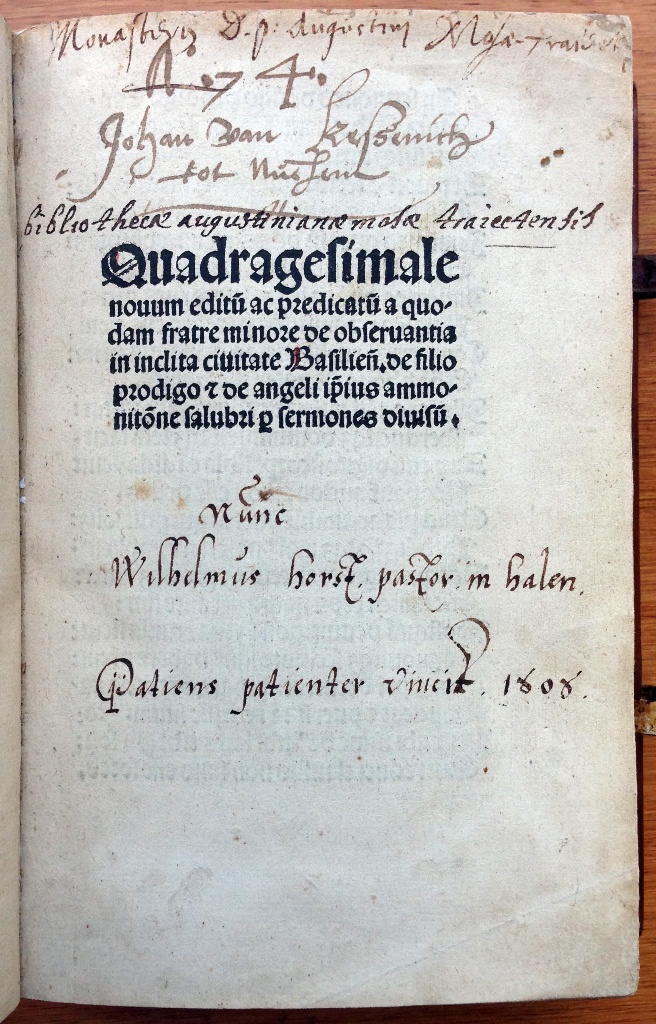
Title-page of the Quadragesimale

Judging by the number of inscriptions on the title-page, this copy of Meder’s Quadragesimale certainly travelled, but not very far. All of them can be localised to the province of Limburg in the Netherlands. The earliest is the inscription by Johan van Kessenich, shown above in between two other inscriptions towards the top of the title-page. Kessenich was born ca. 1522, served as steward of the Augustinian cloister of St Elisabeth in Nunhem, and died ca. 1608. The book then passed to a Wilhelm Horst, whose tidy inscription notes that he was a pastor in the town of Haelen (just 1km south of Nunhem), and came into possession of the Quadragesimale the same year as Kessenich’s approximate date of death. The last two pieces of evidence recorded on the title-page puts the book in the library of the Augustijnenkerk (Church of the Augustinians) in Maastricht, about 55km southwest of Haelen.
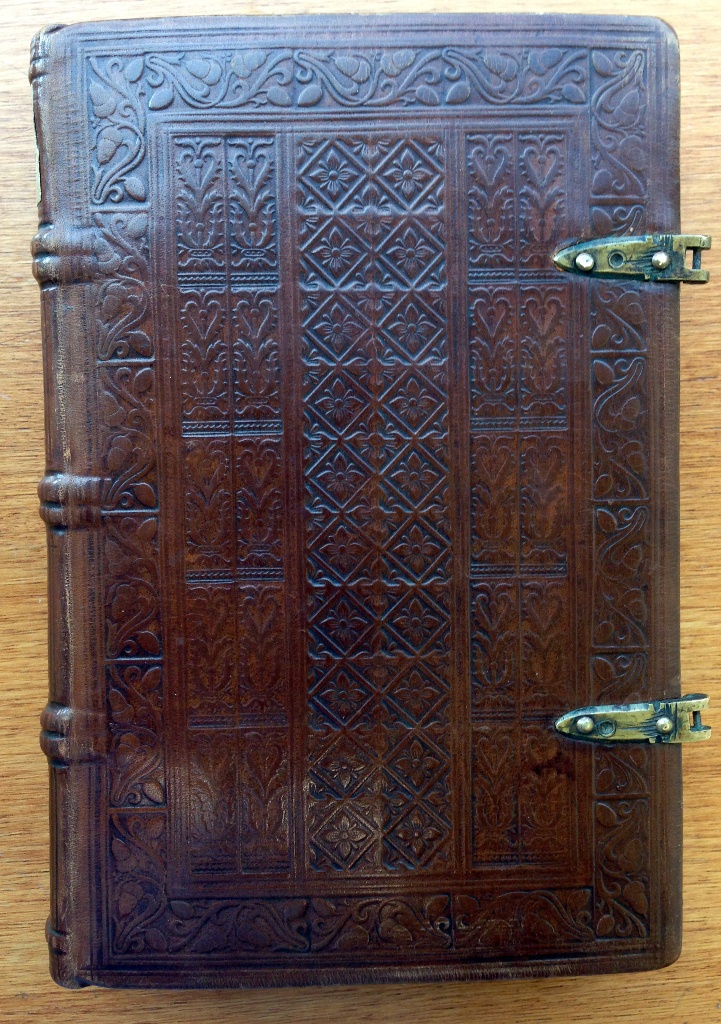
Quadragesimale binding

The book was bound in a contemporary style by the twentieth-century French binder Roger Devauchelle (1915-1993), who preserved the original clasp catches, the paper spine label, and presumably the pastedowns: two fragments from a thirteenth-century Breviary.
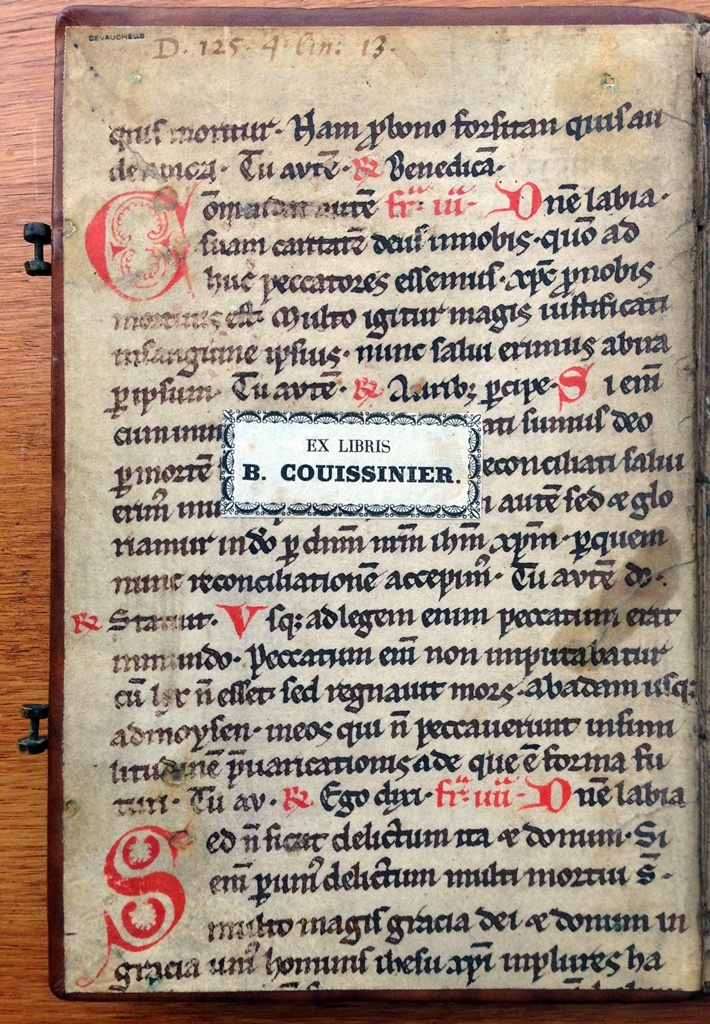
Manuscript pastedown

Affixed to the front pastedown is the book label of ‘B. Couissinier’, and Devauchelle’s stamp can be found in the upper-left corner.[2]

Purchased by the Friends of the Baillieu Library with funds from the George Shaw Trust.

2. Eusebius Pamphilus, [Greek title:] Evangelicae praeparatio lib. XV … [with] Evangelicae demonstrationis lib. X. Paris: Robert Estienne, 1544-1545.

Signature of Rudolf Gwalther

The earliest sign of ownership on Estienne’s 1544 edition of Eusebius is an inscription dated just five years after its publication. It reads: ‘Sum Rodolphi Gualtheri Tigurini 1549′. The owner, Rudolf Gwalther (1519-1586), was a Reformed Protestant pastor in Zurich (‘Tigurum’) who married the daughter of Huldrych Zwingli (1484-1531), one of the leaders of the Reformation in Switzerland. He became head of the Zurich church upon the death of Zwingli’s successor Heinrich Bullinger (1504-1575).
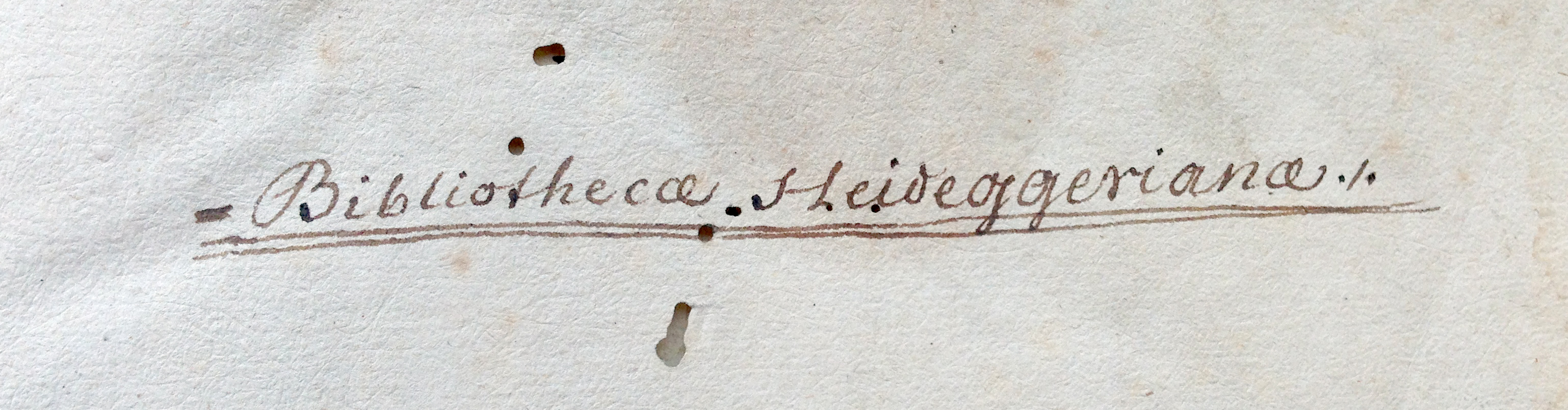
Heidegger collection inscription

The book can next be placed in another Zurich collection, the ‘Bibliothecae Heideggeriana’. This collection was formed by Hans Heinrich Heidegger (1711-1763), whose son, Johann Heinrich (1738-1823), continued to expand the library. A slip pasted on the front free endpaper with the date ’1783′ written upon it suggests the Eusebius was acquired by the younger Heidegger that year. The Heideggeriana collection was sold in 1810 when Johann moved to Geneva.[3]

Stamp of Hachette and Co.

Sometime after the Heidegger sale, the Eusebius made its way to France and into the stock of the great bookshop and publishing house L. Hachette et Compagnie, whose acquisition stamp on the title-page dates to 1918.
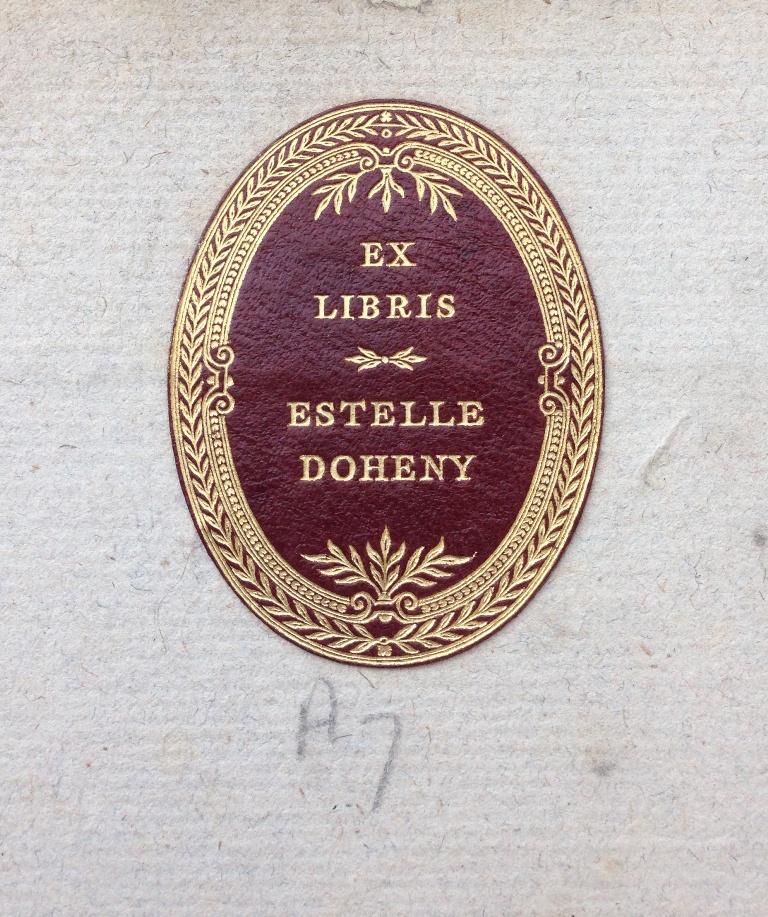
E. Doheny book label

The volume next appeared in the library of Estelle Doheny (1875-1958), who amassed one of the great twentieth-century book collections in America. Doheny left her library, which included a volume of the Gutenberg Bible, to St John’s Seminary in Camarillo, California.[4] In her bequest, Doheny stipulated that the collection must be kept together for 25 years after her death. In 1986, the Archdiocese of Los Angeles and the Seminary Board of Directors made the controversial decision to sell the Doheny collection. The books were auctioned by Christie’s, New York, in six sales held between 1987 and 1989. The Eusebius was sold to Parsons Books in the 1 February 1988 sale (lot 559).[5]

Purchased by the Ivy M. Pendlebury bequest in memory of Gerald Frederic Pendlebury.

3. De recta pronunciatione Latinae linguae dialogus. Antwerp:  Christophe Plantin, 1586.

Stamp of Anton Fugger dated 1586

This copy of Plantin’s 1586 edition of Lipsius has a long connection to families that wielded financial power. The first being the stamp of Anton Fugger dated 1586. He was a member of a wealthy German banking and merchant family, their financial prospects secured by his namesake, Anton Fugger (1493-1560), whose trade empire extended to the Americas and the West Indies, and who also held mining interests in Scandinavia.
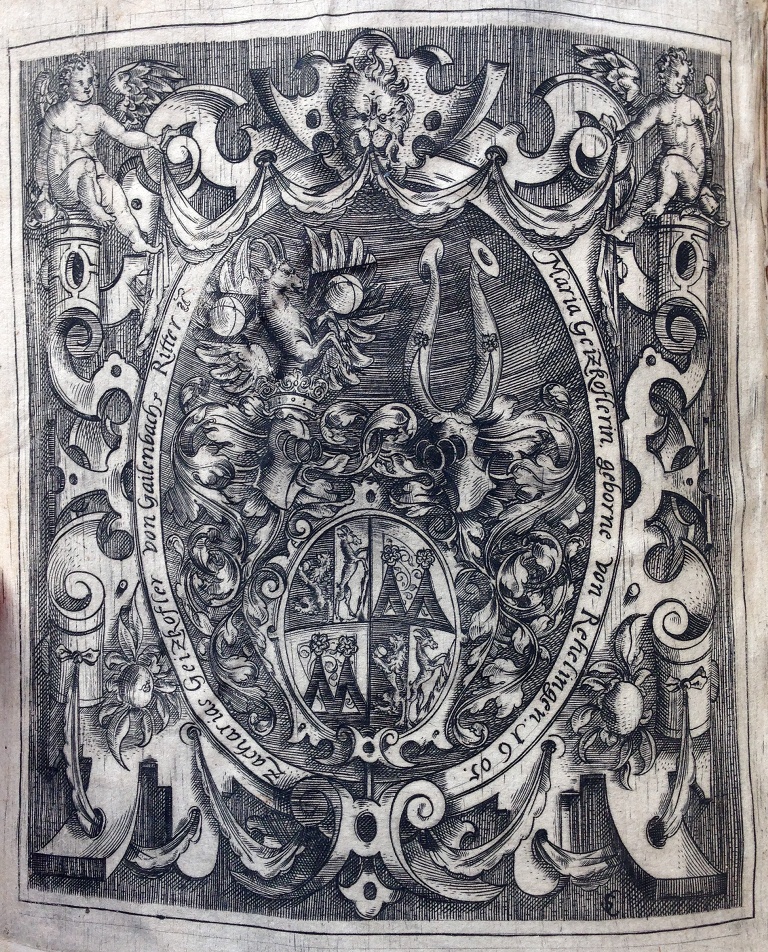
Bookplate of Zacharias Geizkofler von Gailenbach

This beautifully engraved bookplate is the most physically impressive piece of provenance evidence found among these three books. Measuring 17 x 14 cm, the ex libris belonged to Zacharias Geizkofler von Gailenbach (1560-1617), who had his name and that of his wife, Maria (nee von Rehelingen), along with her date of birth, engraved along the central oval frame. From 1597, Geizkofler served as Reichspfennigmeister (treasurer) of the Holy Roman Empire, and as an adviser to the emperors Rudolf II (1552-1612) and Matthias (1557-1619).

Lipsius title page

The Lipsius eventually travelled to what was Austria-Hungary. There it came into the possession of the noble Magyar family, Zichy, though which family member has yet to be confirmed. The title-page is stamped with the arms and name of Count Ödön Zichy. This may refer to Count Ödön (1809-1848), a governmental administrator who was executed as a result of a court martial, or Count Ödön (1811-1894), founder of the Oriental Museum in Vienna and a great patron of art and industry.

Bookplate of Jan Szasz

The second Hungarian collector to own this book was Jan Szasz, about whom I have been able to find very little.[6] It appears, however, that Szasz immigrated to the Antipodes, for a number of books with his bookplate are found in Australian institutional and private libraries.

Purchased by the Ivy M. Pendlebury bequest in memory of Gerald Frederic Pendlebury.

---

[1] See A.S.G. Edwards, Nicolas Barker at Eighty: A List of His Publications to Mark His 80th Birthday (New Castle, DE; London: Oak Knoll Press; Bernard Quaritch Ltd., 2013).

[2] Do you recognise the ‘B. Couissinier’ bookplate? If you know who he or she was, please leave a comment or email me at Special Collections.

[3] Selecta artis typographicae monumenta e bibliotheca Heideggeriana sive Catalogus librorum seculo XV impressorum … qui pro adjectis in margine pretiis publica auctionis lege divenduntur d. 18. Jun…(Zurich, 1810)

[4] The Gutenberg Bible volume was purchased by the Maruzen Co. of Tokyo for USD $5.3m (with premium) in the 22 October 1987 sale (lot 1). It was acquired by Keio University Library in March 1996.

[5] The Estelle Doheny Collection … Part III: Printed Books and Manuscripts including Western Americana (New York: Christie, Manson & Woods, 1988) 173 (lot 559)

[6] As with the book label of M. or Mme Couissinier, I would welcome any information on this collector named Szasz.

03 April 2013

Catalogue of Incunabula, Dunedin City Library

Leaf from the Gutenberg Bible (ca. 1455)
A few years ago I began compiling an annotated catalogue of fifteenth-century printing held by the Heritage Collections, Dunedin City Library. That work was set aside when I started my MA thesis. Now, with the thesis completed last August, I have at last been able to finish the work.

The catalogue records seven bound incunabula and more than ninety leaves and fragments, with commentary on the texts, provenance, and printers. I have also included links to fully digitised copies where available.

Highlights from the collection include: one volume of the 1472 Latin Bible printed by Peter Schöffer, the oldest printed book held by the Library; a 1476 edition of the Legenda aurea sanctorum from the noted collections of Sir James Balfour (ca. 1600–1658) and David Dalrymple, Lord Hailes (1726–1792); leaves from the Nuremberg Chronicle (1493), a leaf from William Caxton's first printed edition of The Canterbury Tales (1476/7), a leaf from the Catholicon (1460), and one leaf from the Gutenberg Bible (ca. 1454), the first book printed in Europe using movable type.

Rather than leave the catalogue solely for in-house use, I have uploaded the file (1.6MB) to Google Docs and my academia.edu account. Interested readers are welcome to view/ download the PDF and or share it with others.

A number of individuals provided invaluable assistance. Though these people are thanked in the catalogue introduction, I would like to express my appreciation to them here. Sincere thanks go to:

Jordan Goffin (Providence Public Library), Klaus Graf (University of Freiburg), Farley Katz (San Antonio, Texas), Donald Kerr (Special Collections, University of Otago), Francis Lapka (Yale Centre for British Art, Yale University), Paul Needham (Scheide Library, Princeton University), Stephen Tabor (Huntington Library), Bettina Wagner (State Library, Munich) and Eric White (Bridwell Library, Southern Methodist University).

Special thanks go to Falk Eiserman, Oliver Dunst and Martina Nickel of the Gesamtkatalog der Wiegendrucke for their encouragement and willingness to receive images of unknown leaves and fragments, no matter how small or fragmentary; to Gabriel Swift (Princeton University) for his comments on the initial draft; and to the Berkeley-based bookseller, Ian Jackson, for his kindness in editing the final text.

I make no claims at being an incunabulist, and so welcome any corrections or added information by those more learned than myself.


Latin Bible (1472)

17 March 2013

Medieval Bookbindings Blog

A new blog created by Alexandra Gillespie, Associate Professor in English and Medieval Studies, University of Toronto, with contributions by Emeritus Professor Alexandra Barratt, University of Waikato:

http://medievalbookbindings.com/

Recent posts include a description and very clear images of a sixteenth-century binding and its medieval manuscript endleaves from the Sir George Grey Special Collections, Auckland Libraries, and Alexandra Barratt's discovery last year of vellum quire guards taken from an early ninth-century Carolingian Bible and sewn into a fifteenth-century binding (also in the Grey collection).

Sixteenth-century binding brass hook-clasp fastening and fore-edge book
marks; New Testament, probably Netherlands, late twelfth or early thirteenth century; Auckland Libraries, Sir George Grey Special Collections, Med. MS G.140
Alexandra G. and Alexandra B. have done great work identifying and expanding upon what is known about early bindings, and the manuscript waste found in them, held in New Zealand collections. The site will cover a variety of bibliocentric topics (not just New Zealand and not just bindings), so I am definitely excited about future posts!

If interested in receiving email alerts, click the 'Follow' function icon towards the bottom of the page/ screen (may not appear in Chrome).

20 January 2013

Edward Wakefield's Annotated Copy of Dieffenbach's Travels in New Zealand

The Dunedin City Library is fortunate to hold three first edition copies of Ernst Dieffenbach's two-volume Travels in New Zealand (London, 1843), possibly the most reliable early book on New Zealand's natural environment and Māori culture written not long after the signing of the Treaty of Waitangi (Wattie 140). One copy belonged to the Stamford Institution, Stamford, Lincolnshire. The second copy was owned by Robert McNab (1864–1917), who, in late 1913, donated his collection of 4,200 books to the Dunedin Public Library. The third copy was purchased by another of the Library's major benefactors, Sir Alfred Hamish Reed (1875–1975), whose bookplate is affixed to the front pastedown.

'Presented to Mr E. Wakefield'
The Reed copy provenance, which has remained unknown for decades and gone unrecorded until now, links the book to one of the most important and controversial families active during the early years of New Zealand's colonial period: the Wakefields.

Inscription on front free endpaper
'Presented to Mr E. Wakefield by the Director of the New Zealand Company. April 1843'.

Originally established in London in 1837 as the New Zealand Association, the New Zealand Company's expressed aim was the systematic colonising of Aotearoa. A founder, and the Director of the Company in April 1843, was the politician and colonial promoter (not to mention convicted abductor), Edward Gibbon Wakefield (1796–1862), a principal figure behind much of the early colonisation of South Australia and New Zealand.

E. G. Wakefield's father, Edward Wakefield (1774–1854), was a philanthropist and land agent. During the 1830s and 1840s, Wakefield, Sr. became what the ODNB describes as 'a warm advocate of Edward Gibbon Wakefield's colonization schemes, writing many letters to newspapers and lobbying the cabinet'. He became in some way an agent, which no doubt accounts for Dieffenbach's Travels having been presented to him by the Company rather than by his son personally.

'The Opinion He Has Given ... Seems Extraordinary'
In addition to being owned by Edward Wakefield, there are no fewer than 216 pages with some form of annotation or marginalia by him.


The sections most heavily marked up are Dieffenbach's general remarks (with attention paid mainly to New Zealand's natural resources), and his chapters on whales and whalers, geological features, Māori customs and language, and the nature and impact of disease on Māori. Nearly all of Wakefield's annotations do not comment on the text or record his thoughts about it, but serve rather as handy reference points to paragraphs or sentences of particular interest.

Wakefield's lone comment related to Dieffenbach's thoughts on the alteration of Polynesian dialects due to the influence of foreign countries, which he believed caused local traditions to be forgotten, and the impact of English (specifically through the Bible in translation) upon Pacific languages. 'New conceptions, new ideas, are pouring in upon these simple and interesting islanders, which importantly affect their language. Every day diminishes ... the chance of recording the different dialects in their purity' (2:304). Dieffenbach's astute (if somewhat condescending) observations struck Wakefield, who wrote on the opposite page:


'The opinion he has given at p. 304 seems extraordinary[.] If the dialects are now so altered then the traditions are forgotten . as a proof none but the old can give an account on the meaning of songs &c'[.]

There is one annotation of particular immediacy (in relation to the date of the gift) and poignancy. On page 94 of the first volume, Wakefield underlined, 'Up to the present time, nearly three years since the purchase, there has not been a single serious misunderstanding between the natives and the European settlers'. In the margin he wrote: 'Natives and European settlers on friendly terms'.

Two months after being given the book, one of Edward's sons, Captain Arthur Wakefield, was killed on 17 June 1843 in the first serious engagement between Māori and the British settlers after the signing of the Treaty of Waitangi. Known as the Wairau Affray, the clash centred around the attempted arrest of the Māori chief Te Rauparaha (ca. 1760s–1849), and left four Māori and twenty-two British dead.

We cannot know for certain when Wakefield read and annotated the text, whether it was before or after Arthur's death. News of the event would not have reached him for months afterwards. The evidence, however, does suggest Wakefield had a specific interest in Te Rauparaha. The first appearance of his name is underlined and is so elsewhere. The names of the Māori chiefs Te Hiko Piata Tama-i-hikoia and Te Werowero are simply noted in the margins, but we find written next to the corresponding printed text in volume one, pages 98 and 99, 'extermination of a tribe by Rauparaha' and 'an account of Rauparaha'.

Te Rauparaha could of course be singled out because he was a well known Māori figure at the time, or perhaps Wakefield wished to learn more about the man he held responsible for the death of Arthur. Either way, these and the other annotations are evidence of careful reading of one of the important early New Zealand books by the father whose sons and grandson are so intertwined with the country's early colonial history.

The Author & Text
Born in Giessen, Germany, Johann Karl Ernst Dieffenbach (1811–1855), was the first trained scientist to live and work in New Zealand. Earning a medical degree in Zurich before being expelled from Switzerland for political agitation and duelling, Dieffenbach sailed for England in 1837 where he changed his name to 'Ernest'. There he befriended such eminent scientists as Charles Darwin, Charles Lyell and Richard Owen. In 1839 Dieffenbach, along with E. G. Wakefield's brother William (1801‒1848), and son, Edward Jerningham (1820‒1879), set sail for New Zealand as naturalist to the New Zealand Company.

Working in a time before science was split into narrow specialisations, Dieffenbach recorded natural features, wrote of the Māori people, their language, customs and beliefs, with insightful understanding. For example, though Dieffenbach found the act of cannibalism and certain other customs detestable, he suggested that 'If one were to reckon up the crimes and gratuitous cruelties ... which civilized men have committed against the savage, the balance of humanity, and of other virtues too, would probably be found on the side of the latter' (2:131)  

Dieffenbach was not embroiled in land purchases from the Māori, and regretted as a theorist and as a man the possible extinction of a native people. Because of his non-alignment with the Company (his contract expired in 1841), missionaries or Government, Dieffenbach was able to suggest ways to protect the Māori from colonisation in his chapter 'How to Legislate for the Natives of New Zealand' (v.2 chap. 9). With remarkable foresight he also realised what the impact could be of introducing alien flora and fauna to the colony: 'what a chain of alterations ... takes place from the introduction of a single animal into a country where it was before unknown' (2:416). An environmental issue New Zealand struggles with to this very day.

In 1845, Edward Jerningham Wakefield, who became an MP in the first New Zealand Parliament, published his own account of New Zealand as Adventures in New Zealand From 1839 to 1844. The historian E. H. McCormick compared the reporting styles of Dieffenbach with that of the young Wakefield in his Letters and Art in New Zealand (Wellington, 1940). He described Wakefield's work as 'all animation and colour and youthful prejudice', which could not have been more different from Dieffenbach who was 'sober, rather heavy-handed in narrative, judicial in his views and statements and possessed of that stability and depth of character which Jerningham so entirely lacked' (McCormick 24).

----

Nelson Wattie. 'Dieffenbach, Ernst or Ernest (1811‒55)' in The Oxford Companion to New Zealand Literature edited by Roger Robinson (Melbourne; Auckland: Oxford University Press, 1998).


For a full account of the Wakefield family, see Philip Temple's A Sort of Conscience: The Wakefields (Auckland: Auckland University Press, 2002).

The text of Dieffenbach's Travels in New Zealand and E. J. Wakefield's Adventures in New Zealand are available on-line through the University of Auckland's Early New Zealand Books project:

Dieffenbach: Volume 1 | Volume 2

Wakefield: Volume 1 | Volume 2