Temporary

20 June 2015

Apologies...

Sorry for the lack of content recently and for letting what was once a rather active blog go fallow. One post (often rehashed) every so many months simply will not do, nor is it fair to anyone who has kindly enjoyed reading what I've written in the past!

There are changes afoot that I hope will remedy this. In a week's time I am returning to New Zealand where I will take up the role of Curator of Rare Books and Fine Printing with the Alexander Turnbull Library as of 13 July.

Those who know me know I prefer to keep this blog professional rather than personal, so I will not go into the reasons why I feel a return to New Zealand will see a return of regular posts to Antipodean Footnotes. I do, however, feel I owed those who read and follow my blog an apology for being completely off my game lately. I very much appreciate your interest in what I have to write about books and book history, and do hope you will bear with me as I turn the page on a new chapter in my life and career.

Will write again once settled into my new position. Until then, sincere thanks for reading this, and take care!

11 April 2015

Publication Announcement: 'Hocken. Prince of Collectors'

Delighted to hear Donald Kerr's book on one of New Zealand's greatest book collectors, Dr Thomas Morland Hocken, will be available in just a couple of months. I'm certainly not alone in saying how much I am looking forward to reading it. Congratulations, Donald!

From the University of Otago Press website:

Dr Thomas Morland Hocken (1836–1910) arrived in Dunedin in 1862, aged 26. Throughout his busy life as a medical practitioner he amassed books, manuscripts, sketches, maps and photographs of early New Zealand. Much of his initial collecting focused on the early discovery narratives of James Cook; along with the writings of Rev. Samuel Marsden and his contemporaries; Edward Gibbon Wakefield and the New Zealand Company; and Maori, especially in the south. He gifted his collection to the University of Otago in 1910. 

Hocken was a contemporary of New Zealand’s other two notable early book collectors, Sir George Grey and Alexander Turnbull. In this magnificent piece of research, a companion volume to his Amassing Treasures for All Times: Sir George Grey, colonial bookman and collector (2006), Donald Kerr examines Hocken’s collecting activities and his vital contribution to preserving the history of New Zealand’s early post-contact period.

PUBLICATION DETAILS: Hocken. Prince of Collectors by Donald Kerr 
Otago University Press http://www.otago.ac.nz/press
Jacketed hardback, 155 x 240 mm 
424 pp & 40 pp photos 
ISBN 978-1-877578-66-3, $60.00
IN-STORE: JUNE 2015

--

For more on Hocken and his collection, see the Hocken Library website:

05 March 2015

'The Book Beautiful' at the Alexander Turnbull Library

[Guest post by Ruth Lightbourne, Curator of Rare Books and Fine Printing, Alexander Turnbull Library]

A new exhibition 'The Book Beautiful' opens in the Turnbull Gallery on Monday 2nd March. This promises to be a feast for the eyes and is something not to be missed: http://natlib.govt.nz/visiting/wellington/the-turnbull-gallery.

A number of events are hosted in conjunction with the exhibition.

The first related events:
On Tuesday 3rd March 5.30-6.30pm in the Te Ahumairangi rooms on the Ground Floor at the National Library, Dr Claire Bolton will give a talk 'Imperfect impressions: clues to 15th century printing practices'. Her talk will be accompanied by colourful slides. All are welcome. Dr Bolton, who teaches printing and this year tutored a course on 15th century books at the London Rare Book School, also ran the Alembric Press in Oxford, England, for over 45 years. For more information, see http://natlib.govt.nz/events/imperfect-impressions.

On Saturday 7th March 2-3pm, Alison Furminger will be giving a class in beginners calligraphy in the Te Ahumairangi rooms on the Ground Floor at the National Library. This event is limited to 20 participants, and booking is required. See the National Library website for details on how to book http://natlib.govt.nz/events/beginners-calligraphy-mar-7. The class will be repeated on Saturday 21 March. 

Other events:
~ Visit to the Waiteata Press (a working hand press) http://natlib.govt.nz/events/letterpress-rules-mar-13
~ Trip to the printing department at Massey to observe printmaking
~ A visit to the National Library conservation lab to watch the Library's conservators at work http://natlib.govt.nz/events/conservation-and-the-book-beautiful
~ Readings from old and middle English by Emeritus Professor Robert Easting http://natlib.govt.nz/events/some-changes-in-the-english-language-chaucer-in-the-middle

Several talks on the arts of the book will be held over the course of the next few months. Some of these events are limited in numbers and booking will be required. Keep an eye out for new additions as there are other events still being finalised http://natlib.govt.nz/events.

28 February 2015

ILAB Pop Up Book Fair + Shakespeare Folios

Will you be in Sydney on 23 April 2015?

If so, be sure to stop by the wonderful State Library of New South Wales for what will be the first in a series of world-wide pop up book fairs organised by the International League of Antiquarian Booksellers celebrating UNESCO World Book and Copyright Day.

Visitors will not only have the chance to browse and buy from some of Australia's leading antiquarian booksellers, but also have the opportunity to make a donation to help raise money for the UNESCO literacy programme.

For the event, which coincides with William Shakespeare's birthday, the library will be displaying all four of its Shakespeare Folios, which includes the only known copy of the 1623 First Folio in Australia.

An antiquarian book fair. The Shakespeare Folios. Advancing literacy. Really, what could be better?

Further details can be found on the ILAB website (http://goo.gl/2x4Lso) and the ANZAAB homepage (http://www.anzaab.com/index.cfm), which notes two other Australian pop up fairs being held in Dunkeld and Hamilton (both in the state of Victoria).

The fairs and exhibition are free and open to the public.

13 January 2015

The Bibliographical Society of Australia and New Zealand Inc. Annual Conference 2015


Turning the Page: Bibliographical Innovation and the Legacy of Aldus Manutius


The University of Melbourne, Australia
Date: 26 and 27 November 2015


2015 marks the quincentenary of the death of the great printer and publisher Aldus Manutius (c. 1451–1515). Aldus was an innovator in a number of ways, from his development and use of the first italic typeface and publishing of small octavo editions, to printing many first editions of classical Greek authors and the production of one of the most beautifully designed and illustrated books of the fifteenth century, the Hypnerotomachia Poliphili.

To honour Aldus’s life and afterlife, the Society invites papers exploring innovation or design in the printed book in any period from the time of Aldus to the modern day. Possible topics can cover any aspect of the history of the book, from bibliography and publishing, to the reading experience and the transition from print to digital format.

Enquiries and proposals of 250 words for papers of 20 to 25 minutes should be sent to Anthony Tedeschi (atedeschi[@]unimelb.edu.au), Special Collections, Baillieu Library, The University of Melbourne. The deadline for paper proposals is Monday 29 June 2015. Students undertaking higher degree research are encouraged to submit offers of ‘work in progress’ papers; some travel bursaries will be available.

Further information and the full conference programme will be posted on the BSANZ Inc. website:


02 December 2014

Dunedin, NZ : UNESCO City of Literature

While not rare book specific, I could not resist posting the fantastic news that my previous home for six and a half years has been designated a UNESCO City of Literature!

Here is the write-up by Eileen Goodwin in today's Otago Daily Times:

Dunedin has stepped on to the international literary stage, late last night being named a Unesco Creative City of Literature.

The designation puts the city on the world map as a first-class literary centre, Dunedin Mayor Dave Cull said.It would help the city attract cultural tourism, tertiary students and new residents, he said.

One of Dunedin's first steps as a City of Literature will be to organise an international conference related to literary culture.

Dunedin was one of four newly designated Cities of Literature - the others were Granada, in Spain, Heidelberg, in Germany, and Prague, in the Czech Republic.

They join existing Cities of Literature Edinburgh, Melbourne, Iowa City, Dublin, Reykjavik, Norwich and Krakow. A country can only have one Unesco City of Literature.

The designation showed the city was ''up there'' with other culturally significant cities, and was not a ''colonial outpost'', Mr Cull said.

Coming soon after the city was named the first Gigatown, the designation was further evidence that Dunedin was moving forward, he said.

Dunedin's application highlighted its literary heritage, literary events, institutions and organisations, and its community or writers, playwrights and lyricists.

''It gives us another point of difference,'' Mr Cull said.

''At a local and national level, this announcement will have cultural and economic benefits.

''The value of having a rich culture is evidenced by events such as this year's inaugural Dunedin Writers and Readers Festival, which had an unexpected number of soldout events, and attracted authors with an international profile.

''Being a City of Literature is a great brand and a very fitting one, given that Robbie Burns' statue presides over our central city.''

Dunedin City Council arts and culture group manager Bernie Hawke said six of the existing Cities of Literature backed the bid, and Dunedin was particularly grateful for the support of its sister city, Edinburgh.

''We have been wonderfully supported internationally and locally by writers' groups and trusts, and national writing and publishing associations, as well as the University of Otago.''

---

For more on Dunedin's efforts and literary city profile, see its City of Literature website and Facebook page:

http://www.cityofliterature.co.nz

https://www.facebook.com/cityofliteraturenz

Hats off to the steering committee - Liz Knowles, Noel Waite, Bernie Hawke and Annie Villiers - for all their hard work and a job well done!

10 November 2014

Turnbull Library Rare Books on Tumblr

The Alexander Turnbull Library in Wellington, New Zealand, has launched a Tumblr page for its Rare Books & Fine Printing Collection:

http://turnbullrarebooks.tumblr.com

The page is off to a fun start, with topics ranging from medieval manuscripts and an eighteenth-century geometric binding, to decorative endpapers and the title-page of one of the Turnbull's copies of Aurora Australis, the first book published in Antarctica created by Ernest Shackleton.

A personal favourite is a closeup image of the pigments used on the illuminated title-page of a Persian manuscript:


If you like what you see and have a Tumblr account, do consider following and help build the library's follower base. Enjoy!

24 September 2014

Memorialised in Manuscript: A Unique First World War Honour Roll

[First posted on University of Melbourne Library Collections blog]

Memorial lists recording the names of people who have died in service to their country or local community are a tragic, but important, part of library and institutional collections worldwide. For the First World War alone, Special Collections holds seventeen separate registers published between 1919 and 1926. There is, however, one further register in the collection that was neither printed nor published, but artfully crafted by a member of university staff.

Opening page.
Opening page.

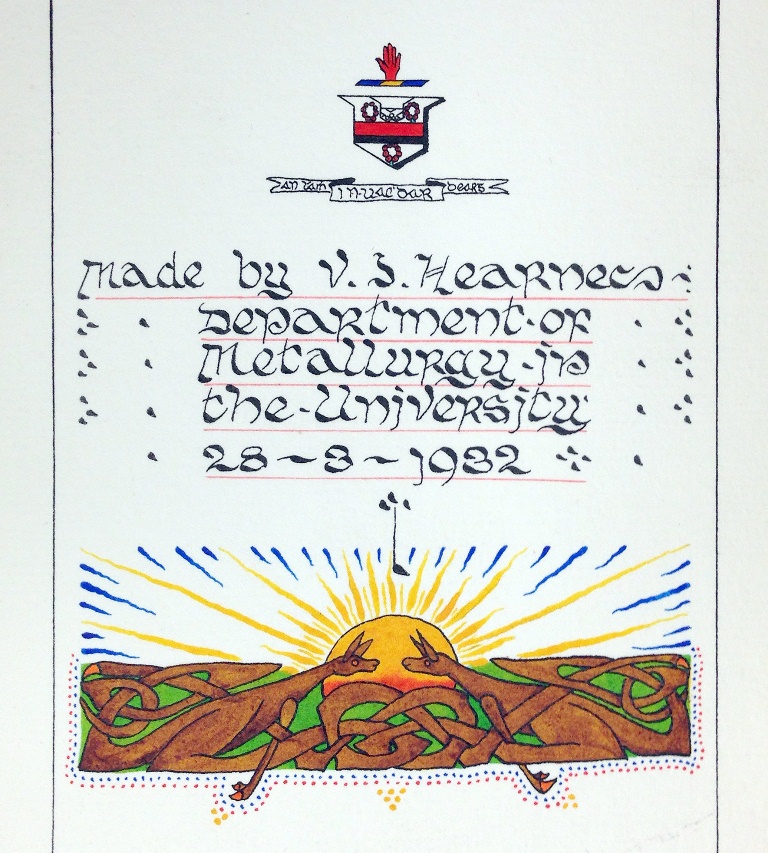
Title-page.
Title-page.

This manuscript Honour Roll was created by Vincent J. Hearnes, who was chief mechanic in the Department of Metallurgy workshop during the early 1930s.[1] According to an index card enclosed in the book, one of Hearnes’ hobbies was the production of books and decorative texts using coloured inks he prepared. This Honour Roll is one surviving example of his work.

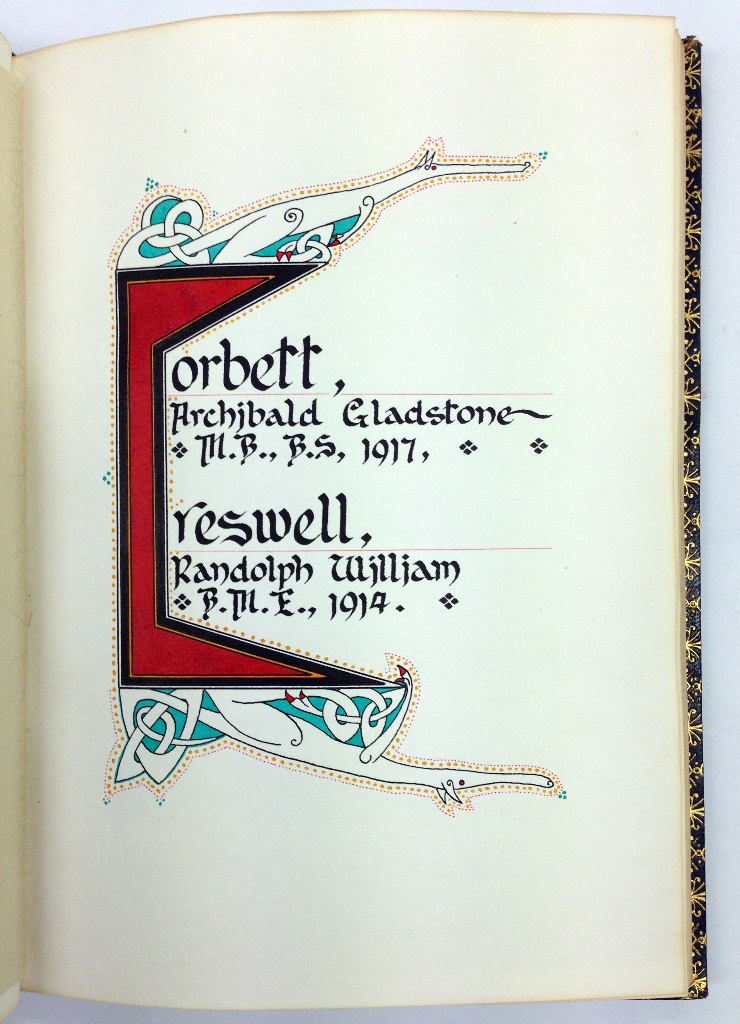
The book consists of 34 hand-decorated leaves recording in a calligraphic script the names of 102 graduates killed on active service between 1914 and 1918.[2] Hearnes was clearly influenced by medieval manuscript decoration and Celtic art, but added an Australian touch by using eccentrically stylised kangaroos and emus to form his knotwork patterns as exemplified in the previous images.

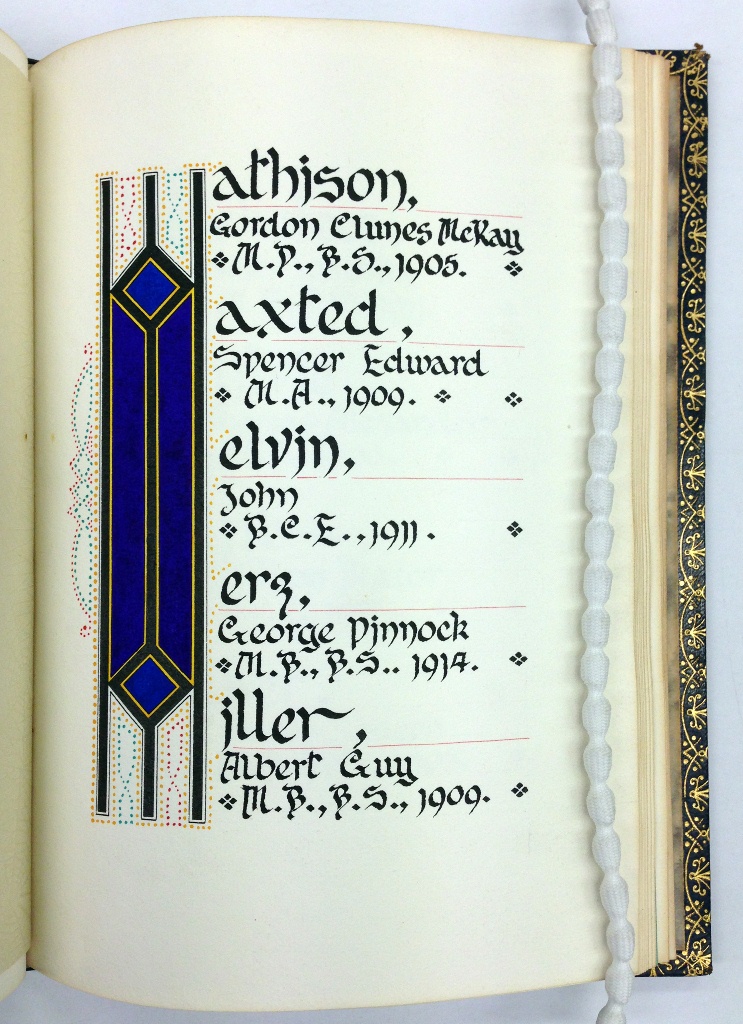
Rather than design decorated initials for each individual name, Hearnes instead used either one large initial for all the names on a given page, such as in the first and third of the following three examples, or incorporated multiple initials into a single design element, e.g. the combination of ‘E’, ‘F’ and ‘G’ in the middle image.

Surnames Corbett and Creswell.


Surnames Elliott to Garnett.


Surnames Mathison to Miller.


Introduction by Professor Earnest Scott, 25.3.1932.
Professor Scott’s Introduction, 25.3.1932.
The work was also a collaborative production. The book was tastefully bound in blue (the university colour) pebble-grained morocco with ornamental gilt turn-ins and marbled endpapers by the prominent Melbourne binder Harry Green. There are brief contributions by Professors L. J. Wrigley (Department of Education) and J. Neill Greenwood (Department of Metallurgy), and an Introduction was provided by noted historian Professor (Sir) Ernest Scott.[3]

When and why did Hearnes compile the manuscript? Thanks to the colophon, we know he completed the Honour Roll in March 1932. The year is significant for two reasons. First, the twentieth anniversary of the outbreak of World War I was just two years away. Second, Melbourne’s war memorial, the Shrine of Remembrance, was under construction and scheduled to open in time with the anniversary in 1934.

To create a record of the Victorians who served overseas between 1914 and 1918, the committee tasked with founding and constructing the Shrine opted to have the names inscribed in a series of Books of Remembrance.[4] To ensure the longevity of the books, they sought the advice of the Victorian Arts and Crafts Society, which specified: ‘The books will be made of the best Roman Vellum, and hand bound in Levant Morocco … The binding would be done by Mr Harry Green, one of the best craftsmen in Australia in the production of Edition de Luxe. The lettering would be done by [Jason] S. Forman and assistants’.[5]

Although Hearnes’ Honour Roll was also bound by Green, he was not among Forman’s assistants, though it seems evident that their work inspired Hearnes to create a similar Book of Remembrance focused on graduates of the university.[6]

The Honour Roll was not the only calligraphic work Hearnes wished to present to the library. In a letter to the Registrar dated 5 April 1933, he wrote: ‘As I mentioned some months ago, I intended having another manuscript book finished for presentation … this year, but owing to illness … I have been unable to do any considerable amount of drawing’.[7] The letter closed with an offer of a third manuscript, one comprised of prayers written alternately in Irish and Latin. Neither book mentioned, however, is held by Special Collections.

Eight months after writing to the Registrar, Hearnes was dismissed from the university due to conflict with other staff, which, it is safe to presume, also ended any inclination on his part to donate further books.[8] This makes the Honour Roll the sole example of his calligraphic work held by the library, and a fitting object to write about, as we enter the final months of the centennial year marking the start of the First World War and prepare to commemorate the centenary of the costly Gallipoli Campaign in 2015.

Colophon dated 28.3.1932.


[1] Essington Lewis, Development and Activities of the Metallurgy School … Melbourne: Melbourne University Press, 1935, p. 7.

[2] For the official university Roll of Honour, see The Melbourne University Magazine: War Memorial Number … Compiled by Graduates and Undergraduates of the UniversityMelbourne: [Printed by Ford & Son for Melbourne University Magazine], 1920.

[3] Scott was knighted in 1939. The School of Historical and Philosophical Studies maintains a chair in his honour, and the university awards an annual prize in Scott’s name, which was established by his widow, Lady Emily Scott (1882–1957).

[4] The books, which number forty in total, are housed in individual bronze caskets displayed in the Ambulatory.

[5] J.B. Forman to Philip Hudson, 10 October 1929; quoted in Bruce Scates, A Place to Remember: A History of the Shrine of Remembrance. Melbourne: Cambridge University Press, 2009, p. 129. Fine vellum proved cost prohibitive, so parchment, cheaper but no less durable, was used.

[6] My thanks to Leigh Gilburt at the Shrine of Remembrance for confirming Hearnes was not among the calligraphers.

[7] V. J. Hearnes to the University Registrar, 5 April 1933; the letter is enclosed with the Honour Roll.

[8] File ‘H. V. [sic] Hearnes Termination of Employment’; University of Melbourne Archives, Office of the Registrar Collection, UM 312, 1933/ 206.
 

15 September 2014

An Apothecary’s Annotations: Eighteenth-Century Medical Notes in a Seventeenth-Century Text

[First posted on University of Melbourne Library Collections blog]

Since 2009, the rare books collection of the Brownless Medical Library has been housed by Special Collections in the Baillieu Library, University of Melbourne. This collection, which numbers 1,850 volumes, is strongest in eighteenth and nineteenth-century material. Some earlier texts are also held, such as sixteenth-century editions of the Galeni librorum quarta classis and La farmacopea o’antidotario dell’eccellentissimo Collegio de’ signori medici di Bergomo (both published in Venice, 1597) and a copy of the 1698 edition of John Browne’s Myographia nova, or, a graphical description of all the muscles in the humane body.[1]
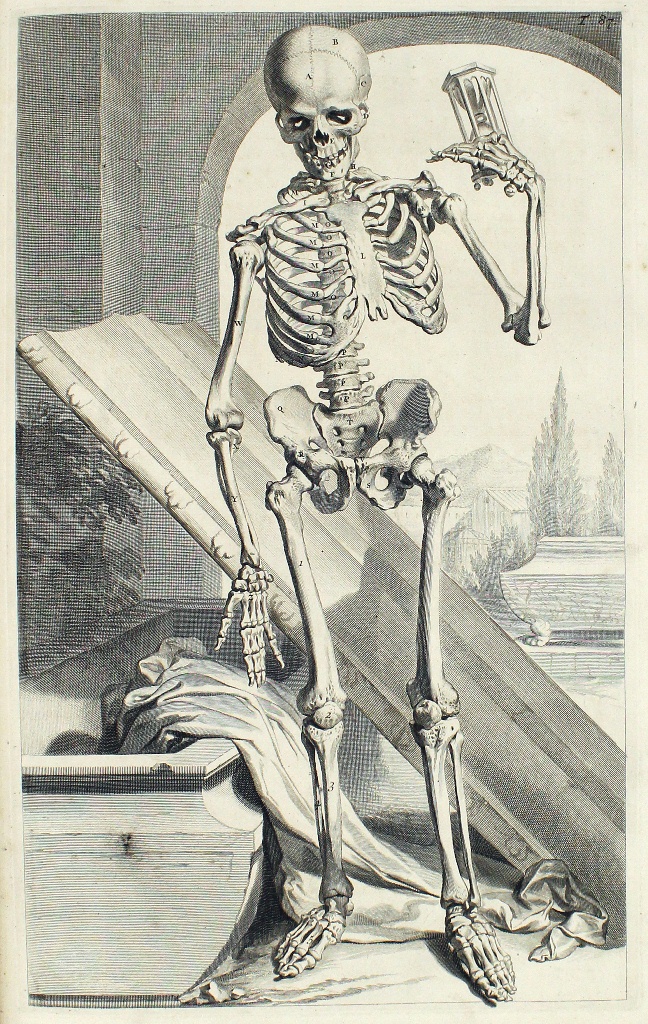
Plate 87. Engraving of a human skeleton in an allegorical pose, likely influenced by Vesalius's De humani corporis fabrica (1543).
Plate 87. Engraving of a human skeleton in an allegorical pose, influenced by Vesalius's De humani corporis fabrica (1543).
Another seventeenth-century anatomical text in the collection is William Cowper’s The anatomy of humane bodies, printed in Oxford for Samuel Smith and Benjamin Walford, printers to the Royal Society, and published the same year as Browne’s 1698 Myographia nova.[2] Cowper’s book is known for its folio-sized anatomical plates by Gérard de Lairesse previously published in Govard Bidloo's Anatomia humani corporis (Amsterdam, 1685), which caused a vitriolic exchange between the two anatomists after Bidloo accused Cowper of plagiarism.[3]

What makes the Melbourne copy of Cowper’s Anatomy particularly interesting are the copious notes written between 1724 and 1740 by an English apothecary, who compiled a combination pharmacopeia and prescription book on the blank versos of sixty-two plates.

The notes refer to treatments for thirty-four diseases or groups of diseases, such as rheumatism, asthma, dysentery, pulmonary tuberculosis, and cancer. In her 2008 study of the book, Dorothea Rowse (Honorary Fellow of the School of Historical and Philosophical Studies and former Sciences Librarian) described the notes as consisting of ‘a comprehensive list of available remedies, evidence of remedies that had been used for named patients, a guide to the physicians recommended for particular medical conditions … and a record of patients who had been treated for serious medical illnesses’.[4]
Notes on breast cancer (verso of plate 19).
Notes on breast cancer treatment (verso of plate 19).
The inclusion of named physicians and patients, some of whom were children, add a very real, very human element. Rowse counted fifteen physicians whose names appear in the notes, along with the names of ninety-three identifiable patients who lived in the vicinity of the village of Hambledon in the county of Hampshire.[5] Her research suggests the author of the notes was Edward Hale, an apothecary and barber surgeon, resident in Hambledon from 1720, whose son (also Edward) continued the practice.[6]

All of the notes are available on the Special Collections Flickr page:[7]

https://www.flickr.com/photos/uomspecialcollections/sets/72157647386329921

Unfortunately, due to the book being rebound, some of the notes run into the inner margin. Anyone consulting them is welcome to contact Special Collections at special-collections[@]unimelb.edu.au for assistance.

Dorothea Rowse’s full account is available on-line as a PDF at the following URL:

 https://www.unimelb.edu.au/culturalcollections/research/collections3/rowse.pdf


[1] The Melbourne copy of Browne’s Myographia nova is from the Chatsworth House library of William Cavendish, 1st Duke of Devonshire (1640–1707). The text was first published in 1681. 

[2] Cowper's The amatomy of humane bodies (London, 1698) purchased with funds from the estate of F. M. Meyer. 

[3] Cowper mentioned neither Bidloo nor de Lairesse in his text. According to Cowper’s ODNB entry, Bidloo 'published a complaint in 1700 addressed to the Royal Society accusing Cowper of plagiarism … which included copies of letters to Cowper, most of which had gone unanswered, correspondence with his publishers, and a list of errors. The Royal Society, with some discomfort, declined to adjudicate on the matter’. 

[4] Dorothea Rowse, ‘The Hampshire Apothecary’s Book: An 18th Century Medical Manuscript in the Baillieu Library’. University of Melbourne Collections issue 3 (Dec. 2008), p. 13. 

[5] Ibid, p. 15. 

[6] Ibid, pp. 16-17. 

[7] To view the original or larger-sized images, single click on the ‘Download this photo’ icon towards the lower right, then select ‘View all sizes’ (‘Large 2048’ file size option is recommended).

08 September 2014

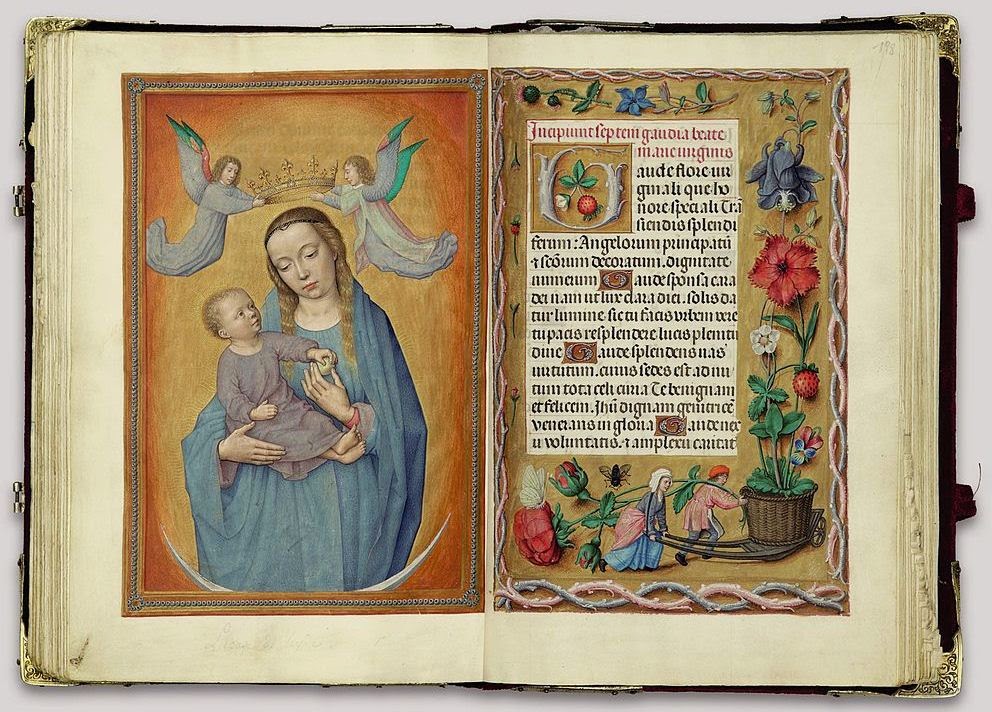
The Rothschild Prayerbook Comes to Australia

Virgin and Child on a Crescent Moon, f.197v.

News is circulating that the exquisite Rothschild Prayerbook (ca. 1505-1510), sold earlier this year by Christie's, New York, for USD $13.6m, was purchased by Australian businessman Kerry Stokes.

Mr Stokes, who also collects works of art and printed books in addition to medieval manuscripts, made his fortune in a variety of industries. His acquisition of the Rothschild Prayerbook featured yesterday on the Channel 7 'Sunday Night' programme. The segment can be viewed here:

https://au.news.yahoo.com/sunday-night/features/a/24909678/mystery-australian-buys-15m-ancient-book/

According to the programme, the manuscript will go on tour next year, with public exhibitions planned for Canberra and Melbourne.

For a description of the Prayerbook, including a number of images, see its entry in Wikipedia, or visit the Christie's on-line catalogue at the following URLs:

http://en.wikipedia.org/wiki/Rothschild_Prayerbook

http://www.christies.com/lotfinder/books-manuscripts/the-rothschild-prayerbook-a-book-of-hours-5766082-details.aspx

10 July 2014

The Gutenberg Bible on Exhibit in Melbourne

Next week sees the launch of the third annual Melbourne Rare Book Week (17 to 27 July). Bibliophiles from across Australasia and beyond will descend upon the city and enjoy an array of talks, demonstrations and exhibitions, ending with the Melbourne Rare Book Fair (25 to 27 July). Visitors to this year’s Rare Book Week will also be able to attend a range of events in the university’s biennial Cultural Treasures Festival (26 and 27 July).

The university will once again host the fair in Wilson Hall, but also add something very special to the 2014 Rare Book Week programme: A 10-day exhibition of the Gutenberg Bible.


The Bible, on loan courtesy of The University of Manchester’s John Rylands Library, will be displayed from 18 to 27 July in the Dulcie Hollyock Room located on the ground floor of the Baillieu Library.

Like all Rare Book Week events, the exhibition is free and open to the public. Viewing hours are 11.00am to 5.00pm daily. Bookings not required.

A series of floor talks connected with the exhibition are also taking place. Details and how to book can be found on the Gutenberg Bible exhibition and Cultural Treasures Festival webpages.

A selection of incunabula and later religious texts from Baillieu Special Collections is also on display on the ground floor of the library in support of the Gutenberg Bible exhibit.

Whether you are local to Melbourne or just visiting, a chance to see a copy of the first substantial book printed in the Western world is not to be missed!

21 June 2014

Warburg Institute: library saved from Nazis awaits its fate

[Originally posted on the Centre for Material Texts bog]

The Times Higher Education Supplement reports that the Warburg Institute library is under threat again, as the University of London heads off to court to contest the terms of a deed of trust made in 1944.
Anyone who has worked in the library, based in the Institute’s building in Woburn Square, will know how special it is. With vast amounts of material, much of it available nowhere else in the UK, and instantly accessible on open shelves, it’s a goldmine for scholar working on the history of European art and literature.
The Warburg apparently runs a £500,000 annual deficit–which is presumably small change for an institution of the size of the University of London. Let’s hope that the administrators can be made to see sense.

09 June 2014

Australasian Rare Books Summer School 2015

The 10th anniversary Australasian Rare Books Summer School will be held 26-30 January 2015 in Wellington, New Zealand. The event is hosted by Victoria University of Wellington and the Alexander Turnbull Library, National Library of New Zealand.

Three exciting courses are on offer, each of which runs for five full days:

History of Cartography/Maps
Tutor: Julie-Sweetkind Singer, Stanford University, USA

Geographic Information Systems for Digital Humanities
Tutor: Ian Gregory, Lancaster University, UK

Artistic Printing
Tutors: Marty Vreede, Quay School of the Arts, Whanganui and Sydney Shep, Wai-te-ata Press, Victoria University of Wellington

Follow the links above for full course descriptions and instructor bios.

The cost of each course is NZD $800 + gst per person. Places are strictly limited.

For more details about RBSS 2015 visit: http://wtap.vuw.ac.nz/wordpress/digital-history/events/rare-books-summer-school/

If you would like to attend, please use the Expression of Interest on-line form, and a member of the RBSS team will contact you with more information.

Hope to see you there!

23 May 2014

Provenance in Pictures: Tracking the Ownership of Three Early Printed Books

[First posted on University of Melbourne Library Collections blog]

Last week a group of Melbourne bibliophiles were treated to a delightful talk by preeminent bookman Nicolas Barker, editor of The Book Collector since 1965, and whose bibliography records an impressive 1,000+ entries.[1]

Barker examined twenty or so works from Special Collections and talked to the salient points of each book. This post highlights three of the selected items that had multiple signs of ownership, all of which caught Barker’s eye.

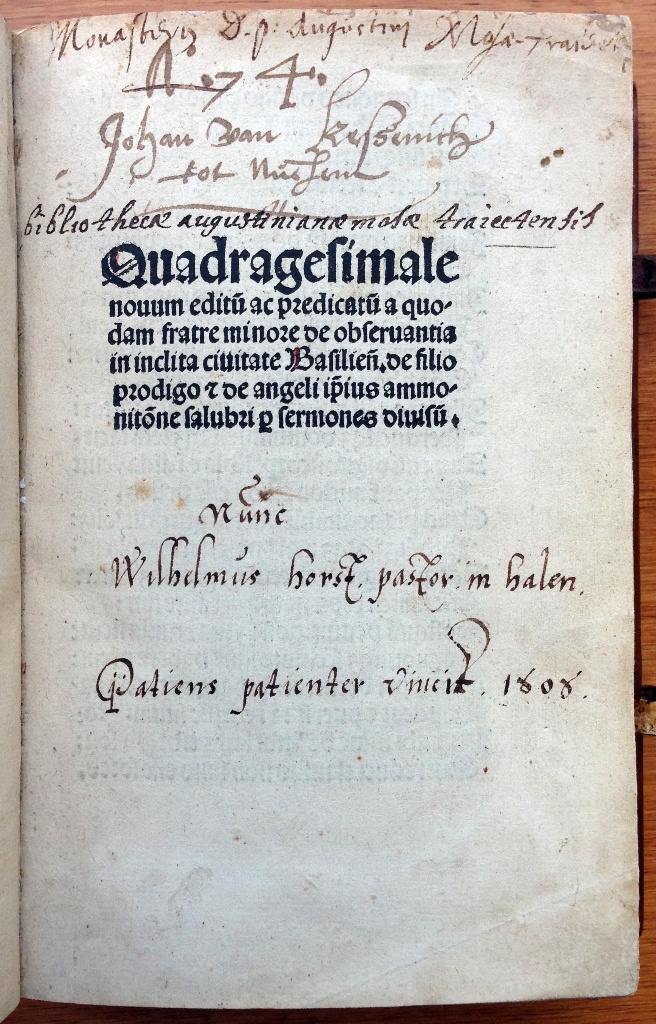
1. Johannes Meder, Quadragesimale de filio prodigo et de angeli ipsius ammonitione salubri per sermones diuisum [Basel: Michael Furter, 1495].

Title-page of the Quadragesimale

Judging by the number of inscriptions on the title-page, this copy of Meder’s Quadragesimale certainly travelled, but not very far. All of them can be localised to the province of Limburg in the Netherlands. The earliest is the inscription by Johan van Kessenich, shown above in between two other inscriptions towards the top of the title-page. Kessenich was born ca. 1522, served as steward of the Augustinian cloister of St Elisabeth in Nunhem, and died ca. 1608. The book then passed to a Wilhelm Horst, whose tidy inscription notes that he was a pastor in the town of Haelen (just 1km south of Nunhem), and came into possession of the Quadragesimale the same year as Kessenich’s approximate date of death. The last two pieces of evidence recorded on the title-page puts the book in the library of the Augustijnenkerk (Church of the Augustinians) in Maastricht, about 55km southwest of Haelen.

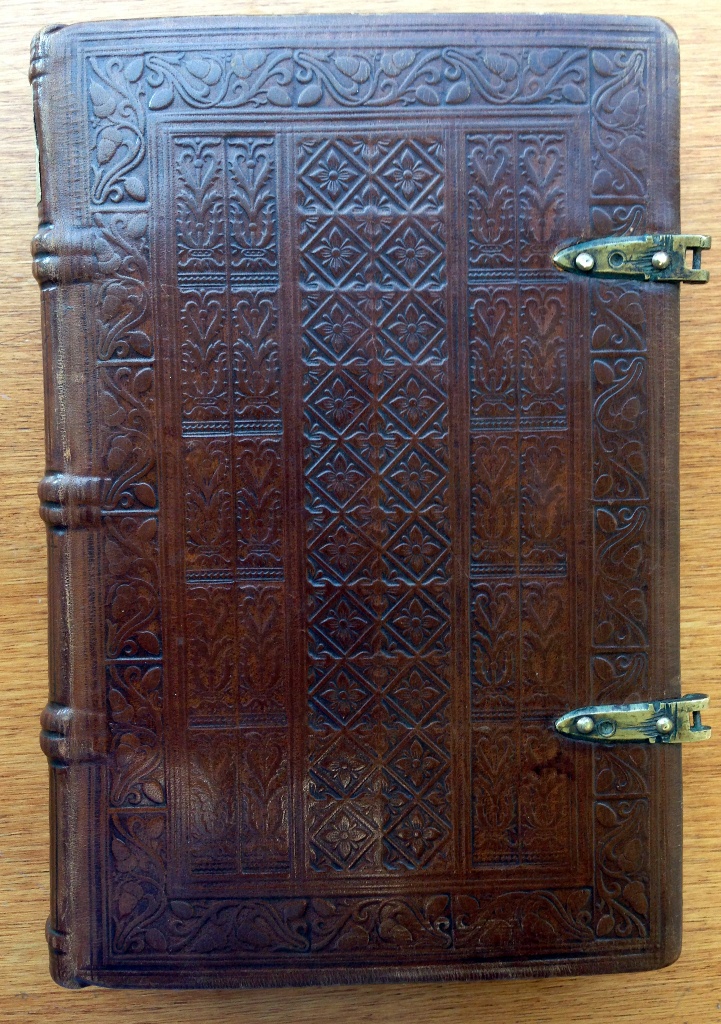
Quadragesimale binding

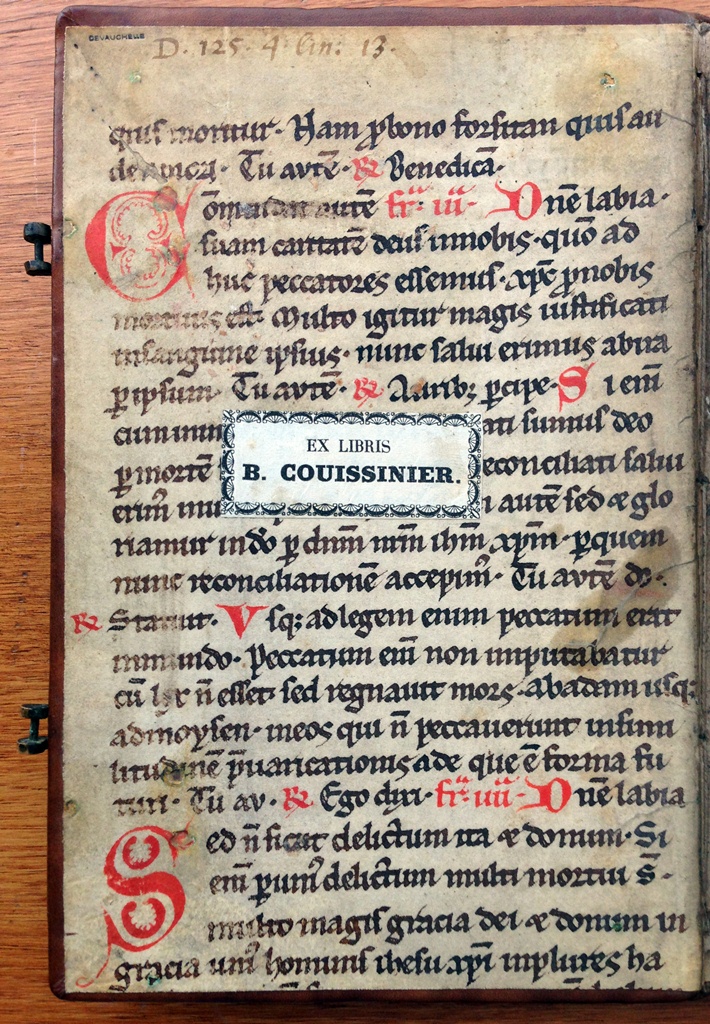
The book was bound in a contemporary style by the twentieth-century French binder Roger Devauchelle (1915-1993), who preserved the original clasp catches, the paper spine label, and presumably the pastedowns: two fragments from a thirteenth-century Breviary.

Manuscript pastedown

Affixed to the front pastedown is the book label of ‘B. Couissinier’, and Devauchelle’s stamp can be found in the upper-left corner.[2]

Purchased by the Friends of the Baillieu Library with funds from the George Shaw Trust.

2. Eusebius Pamphilus[Greek title:] Evangelicae praeparatio lib. XV … [with] Evangelicae demonstrationis lib. X. Paris: Robert Estienne, 1544-1545.

Signature of Rudolf Gwalther

The earliest sign of ownership on Estienne’s 1544 edition of Eusebius is an inscription dated just five years after its publication. It reads: ‘Sum Rodolphi Gualtheri Tigurini 1549′. The owner, Rudolf Gwalther (1519-1586), was a Reformed Protestant pastor in Zurich (‘Tigurum’) who married the daughter of Huldrych Zwingli (1484-1531), one of the leaders of the Reformation in Switzerland. He became head of the Zurich church upon the death of Zwingli’s successor Heinrich Bullinger (1504-1575).

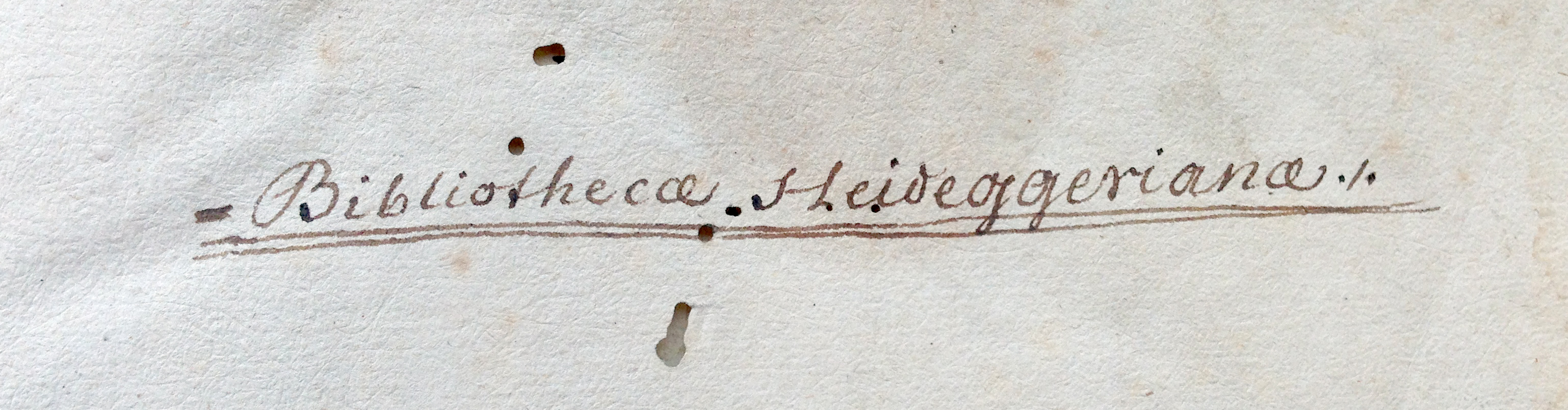
Heidegger collection inscription

The book can next be placed in another Zurich collection, the ‘Bibliothecae Heideggeriana’. This collection was formed by Hans Heinrich Heidegger (1711-1763), whose son, Johann Heinrich (1738-1823), continued to expand the library. A slip pasted on the front free endpaper with the date ’1783′ written upon it suggests the Eusebius was acquired by the younger Heidegger that year. The Heideggeriana collection was sold in 1810 when Johann moved to Geneva.[3]

Stamp of Hachette and Co.

Sometime after the Heidegger sale, the Eusebius made its way to France and into the stock of the great bookshop and publishing house L. Hachette et Compagnie, whose acquisition stamp on the title-page dates to 1918.

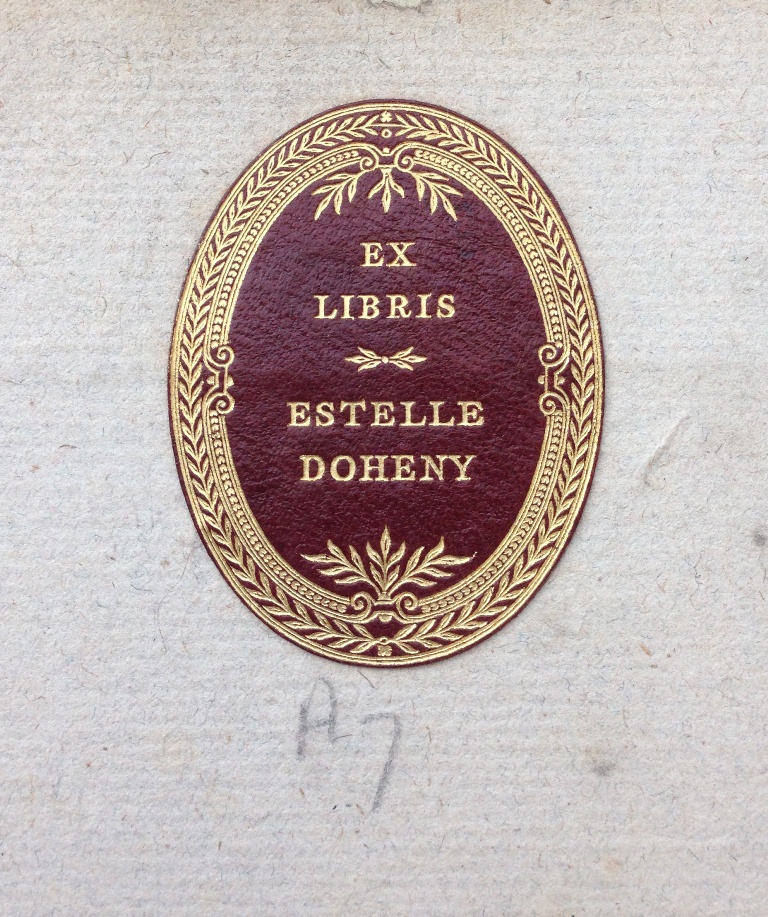
E. Doheny book label

The volume next appeared in the library of Estelle Doheny (1875-1958), who amassed one of the great twentieth-century book collections in America. Doheny left her library, which included a volume of the Gutenberg Bible, to St John’s Seminary in Camarillo, California.[4] In her bequest, Doheny stipulated that the collection must be kept together for 25 years after her death. In 1986, the Archdiocese of Los Angeles and the Seminary Board of Directors made the controversial decision to sell the Doheny collection. The books were auctioned by Christie’s, New York, in six sales held between 1987 and 1989. The Eusebius was sold to Parsons Books in the 1 February 1988 sale (lot 559).[5]

Purchased by the Ivy M. Pendlebury bequest in memory of Gerald Frederic Pendlebury.

3. De recta pronunciatione Latinae linguae dialogus. Antwerp:  Christophe Plantin, 1586.

Stamp of Anton Fugger dated 1586

This copy of Plantin’s 1586 edition of Lipsius has a long connection to families that wielded financial power. The first being the stamp of Anton Fugger dated 1586. He was a member of a wealthy German banking and merchant family, their financial prospects secured by his namesake, Anton Fugger (1493-1560), whose trade empire extended to the Americas and the West Indies, and who also held mining interests in Scandinavia.

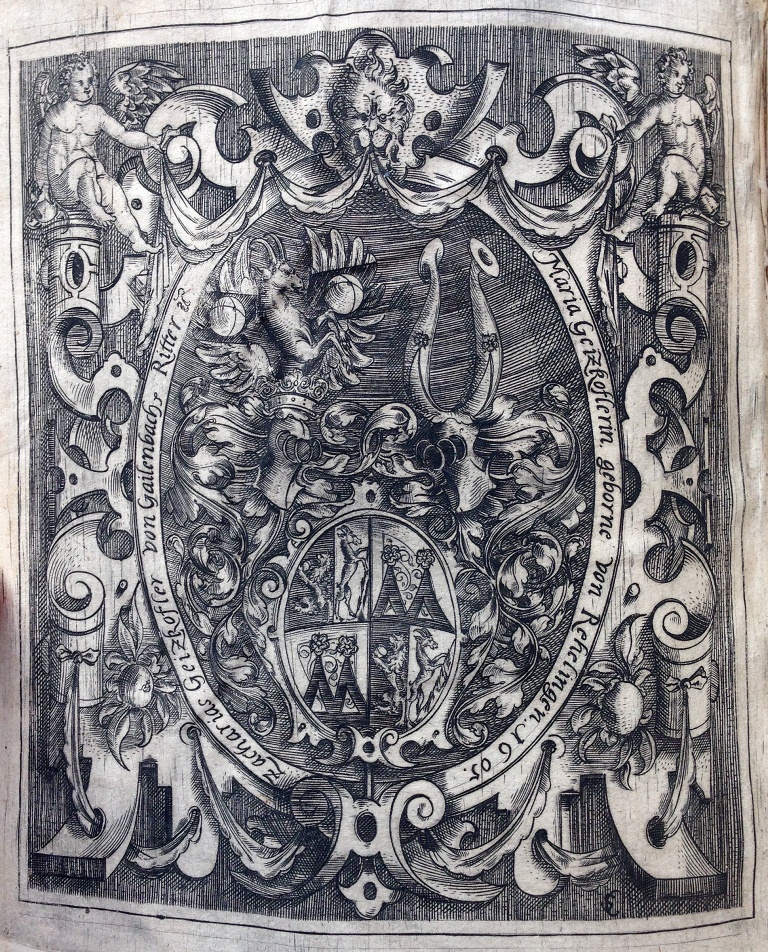
Bookplate of Zacharias Geizkofler von Gailenbach

This beautifully engraved bookplate is the most physically impressive piece of provenance evidence found among these three books. Measuring 17 x 14 cm, the ex libris belonged to Zacharias Geizkofler von Gailenbach (1560-1617), who had his name and that of his wife, Maria (nee von Rehelingen), along with her date of birth, engraved along the central oval frame. From 1597, Geizkofler served as Reichspfennigmeister (treasurer) of the Holy Roman Empire, and as an adviser to the emperors Rudolf II (1552-1612) and Matthias (1557-1619).

Lipsius title page

The Lipsius eventually travelled to what was Austria-Hungary. There it came into the possession of the noble Magyar family, Zichy, though which family member has yet to be confirmed. The title-page is stamped with the arms and name of Count Ödön Zichy. This may refer to Count Ödön (1809-1848), a governmental administrator who was executed as a result of a court martial, or Count Ödön (1811-1894), founder of the Oriental Museum in Vienna and a great patron of art and industry.

Bookplate of Jan Szasz

The second Hungarian collector to own this book was Jan Szasz, about whom I have been able to find very little.[6] It appears, however, that Szasz immigrated to the Antipodes, for a number of books with his bookplate are found in Australian institutional and private libraries.

Purchased by the Ivy M. Pendlebury bequest in memory of Gerald Frederic Pendlebury.

---

[1] See A.S.G. Edwards, Nicolas Barker at Eighty: A List of His Publications to Mark His 80th Birthday (New Castle, DE; London: Oak Knoll Press; Bernard Quaritch Ltd., 2013).

[2] Do you recognise the ‘B. Couissinier’ bookplate? If you know who he or she was, please leave a comment or email me at Special Collections.

[3] Selecta artis typographicae monumenta e bibliotheca Heideggeriana sive Catalogus librorum seculo XV impressorum … qui pro adjectis in margine pretiis publica auctionis lege divenduntur d. 18. Jun…(Zurich, 1810)

[4] The Gutenberg Bible volume was purchased by the Maruzen Co. of Tokyo for USD $5.3m (with premium) in the 22 October 1987 sale (lot 1). It was acquired by Keio University Library in March 1996.

[5] The Estelle Doheny Collection … Part III: Printed Books and Manuscripts including Western Americana (New York: Christie, Manson & Woods, 1988) 173 (lot 559)

[6] As with the book label of M. or Mme Couissinier, I would welcome any information on this collector named Szasz.

04 May 2014

Original Les Miserables Manuscript on Its Way to Melbourne

[The following is from the Herald Sun website]

The original 1862 manuscript of Les Miserables — considered one of the greatest novels of the 19th century — is on its way to Melbourne.

Victor Hugo’s 945-page handwritten document will leave the Bibliotheque nationale de France for the first time to be exhibited exclusively at the State Library of Victoria.

Arts Minister Heidi Victoria said the loan to Melbourne was an act of enormous trust and generosity by the French people.

“It is also significant that the State Library of Victoria is the first institution that France has entrusted this great work to,” she said.

Victor Hugo’s handwritten manuscript. Source: Supplied

[Exhibition] curator Tim Fisher said the “talismanic object” would be the centrepiece of the library’s forthcoming exhibition 'Victor Hugo: Les Miserables From Page to Stage', which coincides with a new production of Les Miserables premiering at Her Majesty’s Theatre.

“Victor Hugo had this amazing way of writing, where he would write down one side of the page and then sometimes, years later, go back and make corrections or additions,” Mr Fisher said. “It’s not a neat object; it is full of humanity.”

Victor Hugo started working on Les Miserables in 1845, completing it 17 years later in Guernsey, where he had been living in exile after declaring Napoleon III a traitor to France.

Les Miserables has been translated into 20 languages, reprinted at least 248 times, been adapted for cinema at least 50 times, and is the foundation for three major musical adaptations.

'The Victor Hugo: Les Miserables From Page to Stage' exhibition also features the six quills Hugo used to write the manuscript, portraits of the author, photographs of scenes from various movie, theatre adaptations and comic books.

'Victor Hugo: Les Miserables From Page to Stage' opens at the State Library of Victoria on 17 July. Visit victorhugoexhibition.com.au

29 March 2014

Australia's First Banknote Sells for $334,000

[The following is from Auction Central News]

SYDNEY (AFP) – The only surviving example of Australia's first official banknote exceeded expectations when it was auctioned for AUD $334,000 (USD $310,000), officials said Thursday.
The 10 shilling note – one of 100 issued in 1817 by the Bank of New South Wales (now called Westpac) on the day it opened – attracted bids from around the world, said Jim Noble of Noble Numismatics, which handled the sale.
"It's a record for a colonial banknote," he told AFP. "It will stay in Australia (but) I've no idea what the gentleman who bought it plans to do; he's a high up executive in a big organization.”
The auction price easily exceeded its Aus$250,000 estimate, with Noble attributing the interest to its unique historical value.
"It's the only one of its kind, even Westpac does not have one," Noble said.

Australia's first banknote. Image courtesy of Noble Numismatics.


Noble said the note was discovered in a private collection in Scotland in 2005, with Scots-born former New South Wales governor Lachlan Macquarie or one of his staff thought to have taken it there.
It was later bought by a private collector who sold it at Wednesday night's auction.
Macquarie arrived in Sydney at the end of 1809 to be confronted by a colony in crisis with no stable monetary system since the First Fleet landed in 1788.
As the new governor, he was given extensive powers to reshape the colony, but despite this his first request to London to establish a bank was rejected.
In 1812, to alleviate the shortage of currency, he imported Ł10,000 in Spanish coins from India and in 1813 manufactured and issued the "Holey Dollar" – one of which sold at auction for a world-record Aus$495,000 last year.
But it was not sufficient and in 1816 he revived his plan for a bank, this time getting London's approval, and on April 8, 1817 the Bank of New South Wales opened for business.