
Towards the end of last year I highlighted a collection of Russian satirical journals and postcards from the 1905 Revolution. Today’s post continues the Russian theme by examining the provenance of an early twentieth-century set of the complete works of Tolstoy.

The set was published in St. Petersburg by P. V. Lukovnikov in 1913 and 1914. It consists of four volumes bound in two. The first two volumes are from the twenty-first edition and volumes three and four from the twenty-sixth and forty-sixth editions respectively. The attractive binding is three-quarter green morocco with marbled boards and pastedowns. In the upper-left corner of the front board on both volumes is a gilt-stamped ownership mark: the Cyrillic letters ‘Λ Β’ (‘L V’) with a crown above:
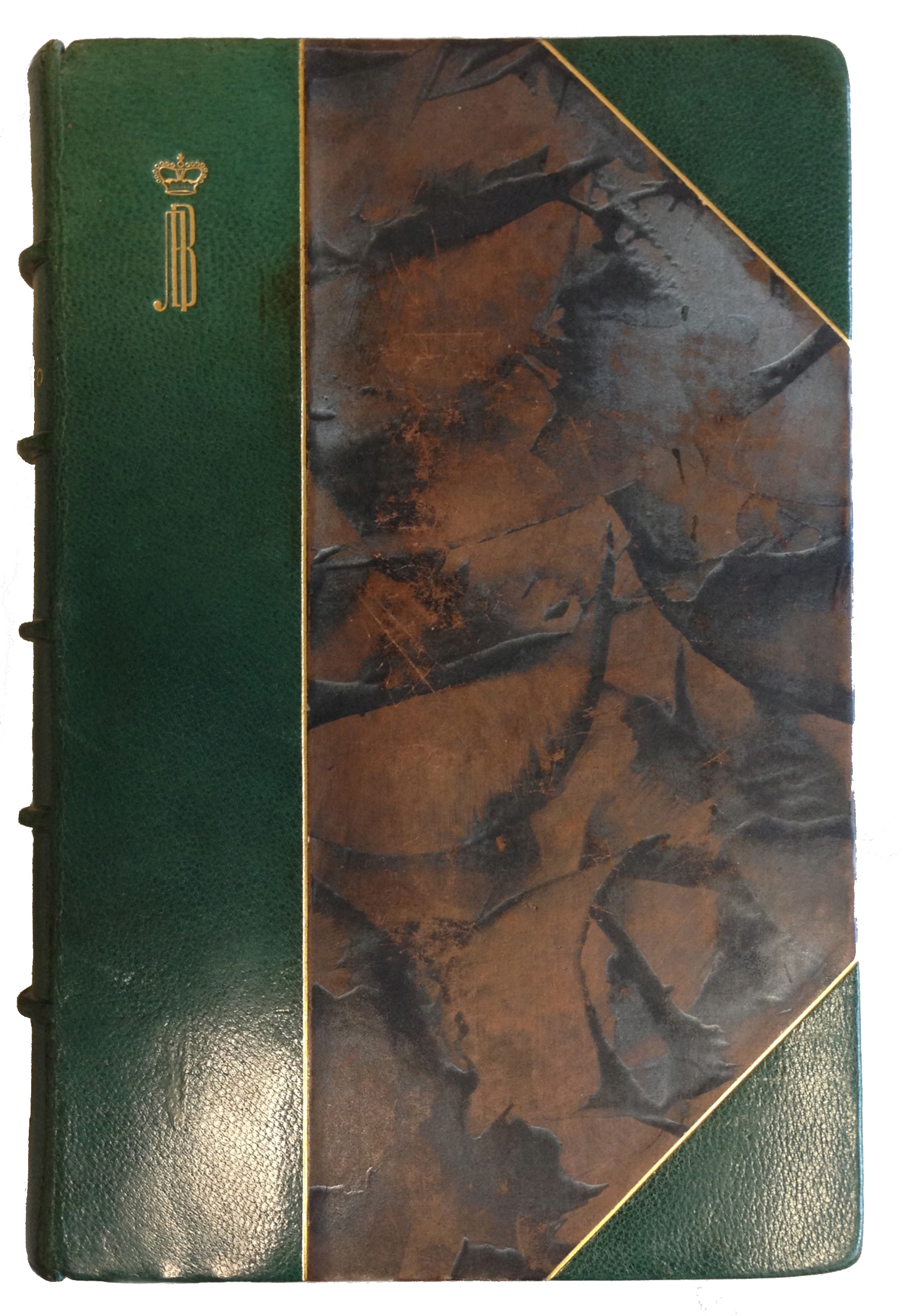
Through a colleague of the antiquarian book dealer Simon Beattie, the ownership stamp has been identified as belonging to Princess Lydia Leonidovna Vyazemsky Vasilchikova (1886–1948). The set is from Vasilchikova’s private library in St. Petersburg and was likely bound by A. A. Schnell, a master bookbinder working for the Russian Imperial Court.
 |
| Portrait of Princess Lydia Leonidovna Vyazemsky Vasilchikova (www.genealogics.org) |
The Family
Lydia’s father was Prince Leonid Dmitrievitch Vyazemsky (1848–1909), a general in the Russian cavalry, Governor of Astrakhan, and member of the Council of the Empire. On 12 May 1909, Lydia married Prince Illarion Sergeyevich Vasilchikov (1881–1969), who belonged to one of Russia’s oldest aristocratic families and served as a member of the Fourth Duma under Tsar Nicholas II.
Lydia, however, was not a stereotypical staid wife of a politician. According to Beattie’s contact, she studied English at Oxford, was fluent in several European languages, and was fond of horse riding and photography. She served as a Red Cross nurse close to the Eastern Front during the First World War, and was awarded four medals, including two St George medals for bravery.
In 1919, the Vasilchikovs fled the upheaval and violence of the 1917 Revolution aboard the SS Princess Ena, sent to Russia by Britain's George V to rescue his aunt the Empress Marie Feodorovna. Destitute, the Vasilchikovs travelled across Europe as refugees to the family's Lithuanian estates. During the Second World War, two of their children, Tatiana and Marie, moved to Berlin in 1940 to find work and were employed by the Foreign Ministry’s Information Office. The sisters later published books about their experiences: Tatiana: Five Passports in a Shifting Europe (1976) and Marie’s Berlin Diaries: 1940–1945 (1988).
The Library
Unfortunately, little information exists regarding the Vasilchikov family libraries, except that they owned several collections in St. Petersburg, Moscow, and throughout their numerous estates. It was learnt through Beattie’s contact that many family members were killed after the 1917 Revolution, and their books sold or intentionally destroyed during the 1920s and 1930s; a sad fate that befell many of Russia’s aristocratic families and their collections during those turbulent early decades of the Soviet Union.
--
Polnoe sobranīe sochinenīĭ gr. A.K. Tolstogo (St. Petersburg: [P. V. Lukovnikov], 1913-1914); from the personal library of Princess Lydia Leonidovna Vyazemsky Vasilchikova; donated to the Melbourne University Library by Mrs. O. P. Hohlov in 1968.


